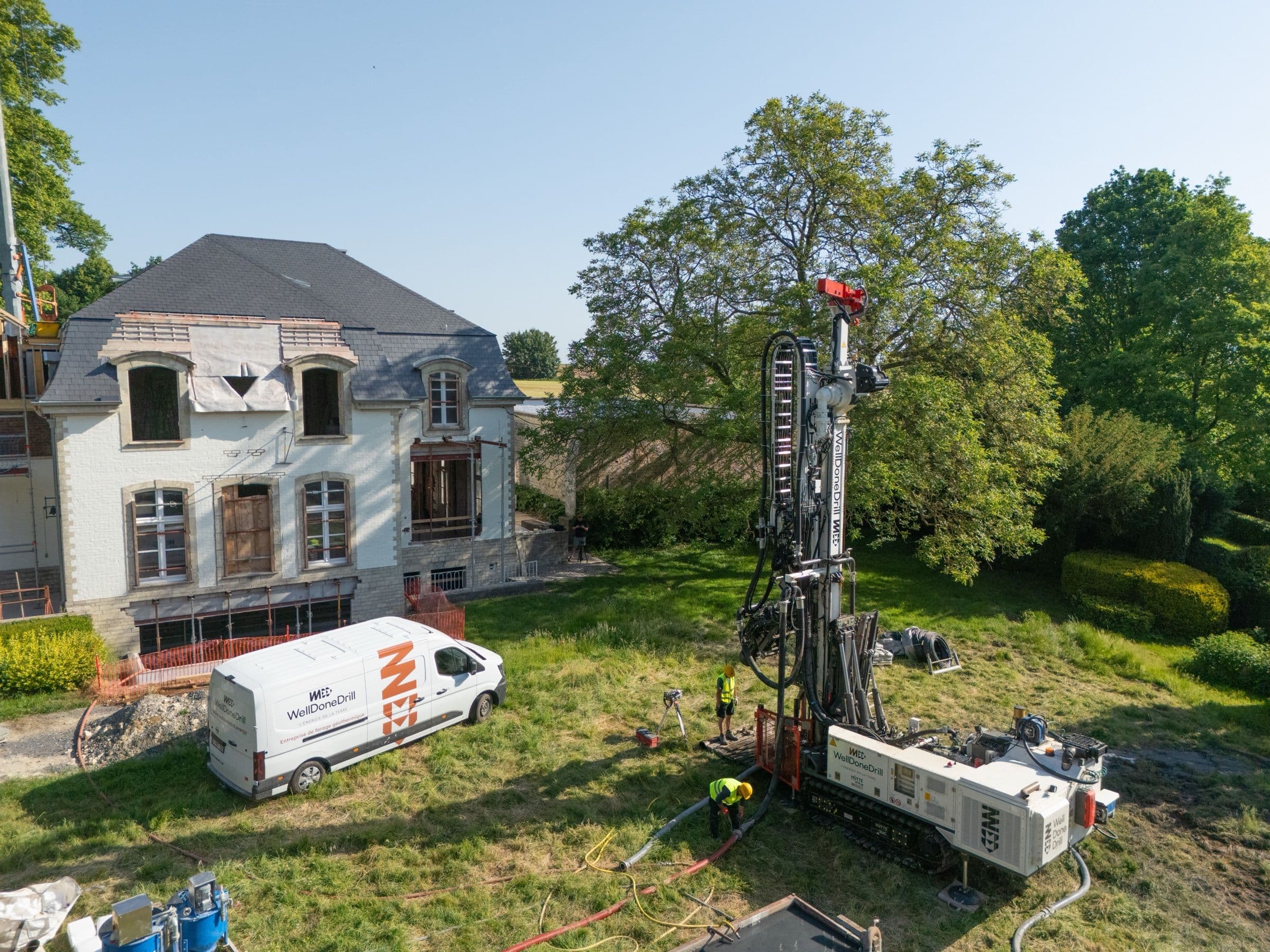

Geothermal heat pump:energy from the ground, all year round.
A geothermal heat pump draws the stable heat of the subsoil to heat your building in winter and cool it in summer. WellDoneDrill drills the boreholes and coordinates the installation, from the free analysis to commissioning.
What is a geothermal heat pump?
A geothermal heat pump, also called a ground-source or water-to-water heat pump, captures the energy stored in the ground through vertical probes installed 80 to 200 m deep. At that depth, the temperature stays stable all year round, whatever the weather outside.
Unlike an air-to-water heat pump, it does not depend on the outdoor temperature: its efficiency stays high in the depths of winter, with no outdoor unit or fan noise. For 1 kWh of electricity, it delivers 4 to 5 kWh of heat.
Check if my plot is suitable
How does a geothermal heat pump work?
- 1
The probes capture heat from the subsoil through a fluid circulating in a closed loop.
- 2
The heat pump, installed inside the building, raises that heat to the required temperature.
- 3
Heat is distributed by underfloor heating, low-temperature radiators or fan coils, and also produces domestic hot water.
- 4
In summer, the coolness of the ground cools the building with almost no consumption: this is geocooling.
The advantages of a geothermal heat pump
High efficiency all year
The ground temperature does not change with the seasons: efficiency stays stable, even in harsh frost.
Warm in winter, cool in summer
The same system heats in winter and cools in summer thanks to geocooling.
Silent and invisible
No outdoor unit or fan: the heat pump sits indoors, the probes are underground.
Controlled bills
Energy from the ground is free: you only pay for the pump’s electricity, at a predictable cost.
No fossil fuel
No combustion, no on-site emissions, no tank or gas connection.
Long-lasting probes
Geothermal probes are designed to last for decades, with no maintenance.
Higher property value
A building heated by geothermal energy achieves a better energy performance rating.
Works with your emitters
Ideal with underfloor heating or low-temperature radiators, in new builds and renovations.
Frequently asked questions about geothermal heat pumps
Don't see your question here? Contact our team directly.
Contact usAn air-to-water heat pump draws heat from outdoor air: its efficiency drops when it is cold, exactly when you need heating most. A geothermal heat pump draws heat from the ground, whose temperature stays stable all year. It offers better seasonal efficiency, needs no outdoor unit and can cool the building in summer almost for free.
The budget depends mainly on the drilling (depth and number of probes) and on the heat pump’s output. The investment is higher than for an air-to-water heat pump, but it is offset by higher efficiency, probes that last for decades and regional grants. Our free analysis gives you a precise budget for your building.
Yes, if they can run at low temperature. Underfloor heating remains ideal, but low-temperature radiators or fan coils also work well. For renovations, we check your emitters during the analysis.
For a house, probes usually go 80 to 200 m deep. The exact depth depends on the geology of your plot and your heating needs, and is calculated during sizing.
WellDoneDrill drills and installs the probes. The heat pump is installed by a partner installer, and we coordinate both teams so you have a single point of contact.
Yes. In summer, the coolness of the ground is used directly to cool the building: this is geocooling. Consumption is limited to the circulation pump, without the noise or the bill of conventional air conditioning.

A geothermal heat pump for your home
Building or renovating? See how a geothermal project works at your home, from the free analysis to commissioning.
Homeowner offer →For large projects
Installers, architects, engineering firms and contractors: we drill for collective housing, commercial and industrial projects.
Professional offer →