
Vertical drilling: why aim for 150 metres deep?
At WellDoneDrill we regularly drill to around 150 metres, but the exact depth is always adapted to the geology of your site. This choice ensures the best efficiency and a long service life for your installation.
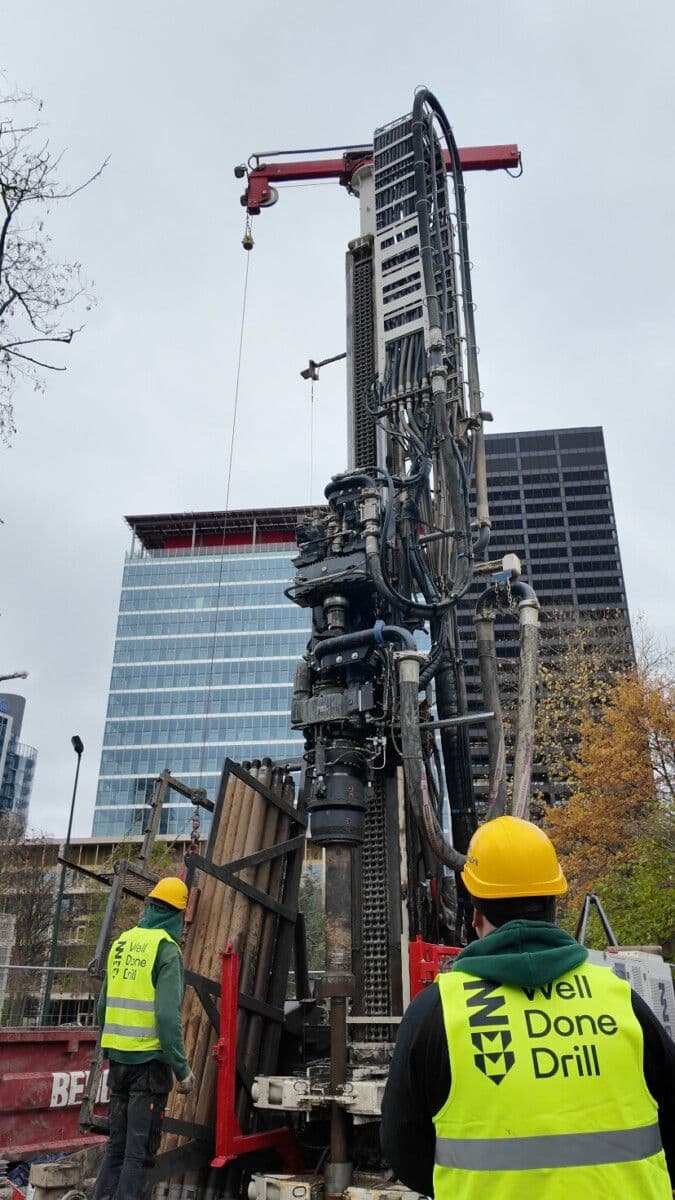
At WellDoneDrill, we regularly drill boreholes reaching around 150 metres deep, but the exact depth is always adapted to the specific geology of your site. This choice is a real strategy to guarantee the best energy efficiency and the longevity of your installation. Going this deep is not a detail: it is what makes the difference.
1. The geothermal gradient: warmer and more stable
The Earth has natural heat that increases the deeper you go into the crust. This is called the geothermal gradient. On average, temperature rises by 3 °C every 100 metres.
- At 10 metres, the ground is still influenced by the seasons.
- At 100 metres, the temperature is stable, around 12 °C to 13 °C in Belgium.
- At 150 metres, we tap an even more constant and slightly warmer energy source.
A difference of a few degrees seems small, but for a heat pump it is crucial. The smaller the temperature gap between the source (the ground) and the emitter (your heating), the less the compressor has to work. The result: a much higher COP (coefficient of performance) and a lower electricity bill.
2. Much greater thermal output
The amount of heat a geothermal probe can extract depends directly on its exchange surface with the ground. Going from 100 m to 150 m doesn't just add 50 % depth: it increases extraction capacity even more, thanks to lithostatic pressure and the often denser, more conductive geological layers.
A 150-metre borehole can deliver 50 % to 70 % more heating output than an 80-metre one. This often makes it possible to cover the entire needs of a large villa or office building with a single deep borehole, where others would need two or three shallower ones.
3. Making the most of the land: the answer for small plots
This is the number one argument for our clients in Brussels and in Wallonia's town centres. When the garden is small, multiplying boreholes is impossible while respecting the safety distances between probes (usually 10 metres, so they don't "steal" each other's heat).
Drilling to 150 metres makes it possible to:
- Concentrate the output on a single entry point.
- Reduce the site footprint.
- Preserve your landscaping (fewer connection trenches, fewer manifolds).
4. A safeguard against thermal depletion of the ground
Ground from which too much heat is extracted without time to recover can end up "freezing" (long-term loss of efficiency). By drawing heat from 150 metres, you tap a much larger volume of rock.
This depth is also ideal for geocooling (passive summer cooling). The cool reservoir at 150 metres is larger and more stable, ensuring effective natural cooling even during long heatwaves, without ever depleting the borehole's thermal capacity.
5. WellDoneDrill expertise: drilling under control
Drilling to 150 metres requires specific equipment and greater technical expertise. Pressures and sediment management are completely different from shallow drilling. With our fleet of compact yet very powerful rigs, we master this verticality to offer our clients the most compact and cost-effective solution on the market.